

 Current position > News detail
『Refrigerant Flow Meter 30 Bar: High-Performance Matching for Standard HFC Networks』Related information(v cone flow meter|rotary gas meter|gallon meter|gear meter|metal tube rotameter|glass tube rotameter|nutating disk meter|transit time ultrasonic flow meter|wedge flow meter|pd meters|hydraulic flow meter|ultrasonic water flow meter|water flow meter|air flow meter|magnetic water flow meter|oxygen flow meter|gas flow meter|argon flow meter|air velocity meter|gasoline flow meter|fuel flow meter|ultrasonic water meter|digital water meter|nitrogen flow meter|solid flow meter|Oxygen tank flow meter|digital water flow meter|diesel fuel flow meter|steam flow meter|02 flow meter|compressed air flow meter|oil flow meter|liquid flow meter)
 ```html
Refrigerant Flow Meter 30 Bar: High-Performance Matching for Standard HFC Networks
Quick Answer: A 30 bar refrigerant flow meter built for standard HFC networks gives you direct mass flow reading without pressure and temperature compensation. Silver Instruments recommends our mini Coriolis meter series in DN4 to DN15, with 4-20 mA HART output and 316L wetted parts, rated PN30 (30 bar) as a drop-in fit. If you handle R134a, R410A, or R32, this meter handles 0.2% of rate accuracy from 0.5 kg/h up to 1,200 kg/h.
Why 30 Bar Rating Matters for Standard HFC Refrigerant Lines
Most industrial refrigeration skids run between 15 and 28 bar on the high side. R410A systems frequently sit at 26 bar liquid line pressure at 40 °C ambient. A meter stamped PN30 gives you a safe margin without jumping to expensive PN40 or PN63 hardware. We have supplied refrigerant flow meters to chiller OEMs in Malaysia and Thailand where 30 bar covers 90 percent of standard HFC batches. In practice engineers want a meter that is not oversized in pressure class but still lets them sleep at night during pull-down cycles. That sweet spot is 30 bar.
HFC Refrigerants That Work with a 30 Bar Coriolis Meter
Standard HFC networks today run on R134a, R404A, R407C, R410A, and increasingly R32. These are single-phase liquids at the metering point, with viscosities around 0.1 to 0.3 cP and densities from 900 to 1,150 kg/m³. Our Coriolis meter detects mass flow directly. You do not need to set up density tables for different HFC blends. A refrigeration plant in Brazil switched from a turbine meter on R404A to our DN10 Coriolis meter and confirmed less than 0.3 percent drift over 14 months, even with oil carryover up to 3 percent.
Meter Construction That Avoids HFC Leak Paths
Leaks in refrigerant flow measurement cost you refrigerant, cooling capacity, and in some countries carbon tax under the Kigali Amendment. The flow meter body must be fully welded with minimal seals. Silver Instruments builds the wetted assembly from 316L stainless steel with secondary containment rated to 30 bar. All process connections are NPT or G thread as standard, DN4 to DN15. No PTFE liners, no O-rings in the flow path. For a customer in the Philippines assembling CO2 / HFC cascade systems, we supplied meters with orbital welded connections directly to their manifold. Zero leak points at the instrument level.
Signal Outputs That Talk to Standard Refrigeration Controllers
Most HFC chiller PLCs expect a 4-20 mA signal for mass flow, plus a pulse output for totalizing refrigerant charge. The transmitter on our 30 bar refrigerant flow meter provides active 4-20 mA HART, scalable pulse, and RS485 Modbus RTU as standard. You can set the 20 mA point to 500 kg/h or 1,200 kg/h via the local display or HART handheld. A facility in Oman using Carel controllers integrated the meter in one morning. They set the zero with the inlet and outlet valves closed, pressure at 22 bar, and saw live mass flow on their supervisor screen by lunchtime.
Accuracy and Turndown for HFC Charge Verification
Factory acceptance test reports show 0.2 percent of rate for liquid HFC from 10 percent to 100 percent of full scale. Turndown is 20:1 on mass flow. If your chiller runs at 300 kg/h nominal and you need to confirm charge at 15 kg/h during commissioning, the same meter covers both points. We have seen this on customer sites in Vietnam where commissioning engineers charge the system gradually and require a flow meter that holds accuracy during low-flow dribble charge. A 30 bar Coriolis meter with DN4 sensors measures down to 0.5 kg/h with repeatability within 0.05 percent.
Installation Tips 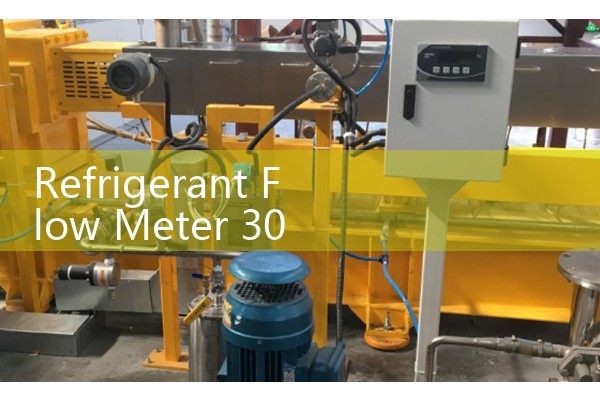
Mount the meter downstream of the filter drier and upstream of the expansion valve. Support the pipe on both sides so the meter body never carries pipe stress. Zero the meter at operating pressure, not at atmospheric pressure. This matters more for HFCs because gas breakout under static zero conditions creates offsets. A refrigeration contractor in Mexico installed three meters without zeroing under pressure and called us about a 1.2 percent offset. Once they zeroed at 25 bar with liquid R410A, the error disappeared. Now they standardize that step.
Silver Instruments Refrigerant Flow Meter 30 Bar Typical Specifications
Here is the configuration that matches standard HFC networks across Southeast Asia, Africa, and the Middle East. Pipe size DN4, DN6, DN10, or DN15. Process connection ½ inch NPT male or G ½ male. Wetted material 316L. Housing stainless steel, IP67. Ambient temperature -40 to 60 °C. Fluid temperature -50 to 150 °C. Pressure rating PN30 (30 bar). Outputs: one 4-20 mA HART passive, one pulse, RS485 Modbus RTU. Power supply 24 V DC. Accuracy 0.2% of rate for liquid. Certifications include CE and ATEX Zone 2 on request. Approximate lead time 2 to 3 weeks from Silver Instruments Nanjing factory.
How to Size a 30 Bar Refrigerant Flow Meter for Your HFC Application
Send us the refrigerant type, liquid temperature in °C, operating pressure in bar, mass flow range in kg/h, and pipe diameter. We will return a sizing sheet with pressure drop calculation, velocity check, and recommended meter code. Most engineers skip the pressure drop step for small DN lines but for R32 at 28 bar the DP can exceed 0.3 bar if the meter bore is undersized. Based on your data we also check for flashing risk upstream of the expansion device.
FAQ: 30 Bar Refrigerant Flow Meter for HFC Networks
Can the same 30 bar meter handle R290 propane?
Yes, but you need ATEX Zone 1 certification and an Ex version. The 30 bar frame stays the same. Specify the hydrocarbon application when requesting a quote. We will confirm wetted materials, purge, and certification requirements.
Do I need a straight run for this Coriolis meter?
No straight run required. Coriolis meters measure mass flow independent of flow profile. You can install directly after an elbow or reducer. This saves space inside compact chiller frames common in Australian rooftops.
How do I verify the 30 bar rating on site?
The meter body has the PN30 marking on the serial plate. Hydrostatic test certificate at 1.5 times rated pressure (45 bar) is included with every shipment. Store the PDF with your pressure vessel documentation.
What about oil in the HFC circuit affecting accuracy?
Polyol ester oil up to 5 percent mass fraction does not shift calibration beyond 0.15 percent. The meter measures total liquid mass flow. If you need net refrigerant mass flow, couple it with a density-based oil content model or oil separator data. We will discuss this with your process team.
Can I get a 4-20 mA loop-powered version only?
Yes. Request the two-wire 4-20 mA HART configuration for simple integration. Pulse and RS485 are additions, not mandatory. The meter draws less than 3.5 mA quiescent current at 24 V DC, which works well with solar-powered remote monitoring stations.
Request a quote for a refrigerant flow meter 30 bar — email [email protected], call +86-135-1213-1526, or reach us on Whatsapp 86-135-12131526 / WeChat +86 13512131526. Tell us your refrigerant, pressure, temperature, DN size, and flow range. We will return a fixed price within 24 hours including freight to your nearest port.
```