

 Current position > Product detail
『Refrigerant Flow Meter Oil Compatible: Tracking Mass Rate Despite Entrained Compressor Oil』Related information(v cone flow meter|rotary gas meter|gallon meter|gear meter|metal tube rotameter|glass tube rotameter|nutating disk meter|transit time ultrasonic flow meter|wedge flow meter|pd meters|hydraulic flow meter|ultrasonic water flow meter|water flow meter|air flow meter|magnetic water flow meter|oxygen flow meter|gas flow meter|argon flow meter|air velocity meter|gasoline flow meter|fuel flow meter|ultrasonic water meter|digital water meter|nitrogen flow meter|solid flow meter|Oxygen tank flow meter|digital water flow meter|diesel fuel flow meter|steam flow meter|02 flow meter|compressed air flow meter|oil flow meter|liquid flow meter)

Refrigerant Flow Meter Oil Compatible: Tracking Mass Rate Despite Entrained Compressor Oil
Quick Answer: Entrained compressor oil changes liquid density and volume, making volumetric flow meters unreliable. A Coriolis mass flow meter reads the true mass flow in kg/h, independent of oil content. Silver Instruments provides oil-compatible Coriolis meters used in HVAC test rigs and compressor durability labs across Southeast Asia and Latin America.
Why Oil Destroys Volume-Based Readings
Refrigerant circuits always carry some compressor oil. Oil mass fractions of 1 % to 5 % are common, and in flooded systems the oil can exceed 8 %. A turbine flow meter or a variable-area meter measures volumetric flow. When oil mixes with liquid refrigerant, the mixture density shifts and the meter calibration fails. In practice, a 3 % oil load can cause a 4 % to 6 % error in a turbine meter. This error drifts as the oil concentration changes with temperature, discharge pressure, and sump level. Many engineers see unstable numbers on the data logger and assume the sensor is broken. The real issue is that the sensor is not oil-compatible.
How a Coriolis Meter Ignores Oil
Coriolis mass flow meters measure fluid inertia through oscillating tubes. The phase shift between the inlet and outlet sensor signals gives a direct mass flow rate. The meter does not need fluid density, viscosity, or the oil-to-refrigerant ratio to output accurate kg/h. Even with 5 % POE oil in R134a, the meter tracks the mass rate within its published accuracy. Silver Instruments SIL-COR series mass flow meter maintains a typical accuracy of ±0.15 % of rate for liquids and a repeatability better than ±0.05 %. The all-stainless steel sensor tube handles high pressures up to 350 bar, common in R744 (CO2) transcritical systems.
Real-World Example: Compressor Calibration Lab
A compressor manufacturer in Vietnam runs a durability bench testing A/C compressors with R410A and polyol ester oil. Their old positive displacement meter required daily recalibration. After installing a DN15 SIL-COR Coriolis meter with HART 4-20 mA output in 2024, the lab logged mass flow and total mass for 500-hour runs without drift. Even when the oil fraction changed from 1.8 % to 4.2 % due to oil carryover, the mass flow deviation stayed under 0.3 %. The lab now uses the same meter for ISO 917 testing and reporting.
Key Specifications for Refrigerant Service
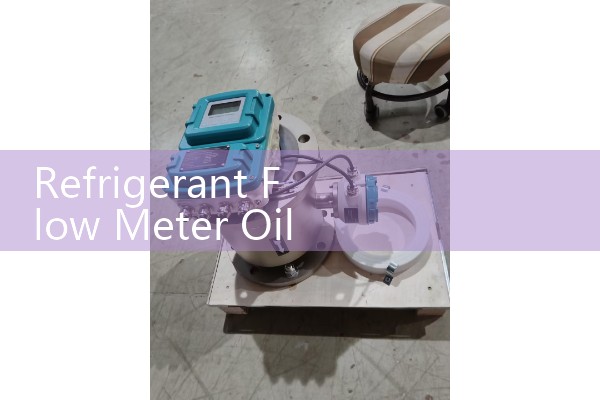
When selecting an oil-compatible flow meter, check the wetted materials, pressure rating, and output. Our SIL-COR Coriolis meter comes with 316L stainless steel tubes, HNBR or FKM O-rings, and a secondary pressure containment option for flammable refrigerants like R290 and R1
Installation Tips for Oil-Laden Refrigerant
Mount the meter in the liquid line after the condenser or receiver, where the refrigerant is subcooled and the oil is fully dissolved. Avoid gas-liquid mix with the Coriolis meter; keep the back pressure high enough to suppress flash gas. A small horizontal loop before the meter can trap excess oil slugs in very oily systems, but it is not required for normal operation. In vertical flow up, the tube vibration helps prevent oil accumulation. No straight pipe runs are needed upstream or downstream.
FAQ on Refrigerant Flow Meters with Oil
Q: Can the Coriolis meter handle up to 8 % oil?
Yes. In our tests and field feedback from refrigeration labs in Thailand and Brazil, a 5 % to 8 % POE oil fraction does not shift the mass flow accuracy beyond the meter specification. The meter output is mass flow, not volume.
Q: Does oil cause tube coating or clogging?
No. The tubes oscillate at high frequency; oil does not coat the wall permanently. Routine flushing with liquid refrigerant cleans the meter. For very waxy oils, a cleaning cycle with solvent can be performed.
Q: What output signals are available?
Standard outputs are 4-20 mA HART with mass flow, density, and temperature. Modbus RTU over RS-485 is also standard. Pulse output for total mass can drive a PLC counter.
Q: Can I use this meter for compressor oil flow, not refrigerant?
Yes. The SIL-COR also measures pure oil flow for lubrication circuit testing. For high-viscosity oils above 100 cP, we recommend a meter with larger tube bore. Send us your oil type and viscosity range.
Q: How fast is the response for transient tests?
The sensor update rate is 100 Hz. The output signal can track fast transients, like compressor start-up oil slug events. You can capture the mass flow spike and oil mass fraction from the built-in density output.
To get a quotation or discuss your refrigerant flow setup, email [email protected]. Include the refrigerant type, oil percentage, mass flow range (kg/h), pipe diameter (DN), and process pressure and temperature. You can also call our application team at +86-25-68650347 or reach us on WhatsApp (+86-25-52155837) and WeChat (+86 15365082610). Visit https://flow-meter.com.au for datasheets and installation drawings.