

 Current position > Product detail
『Refrigerant Flow Meter for Subcooled Liquid: Ensuring Clean Single-Phase Ingest Settings』Related information(v cone flow meter|rotary gas meter|gallon meter|gear meter|metal tube rotameter|glass tube rotameter|nutating disk meter|transit time ultrasonic flow meter|wedge flow meter|pd meters|hydraulic flow meter|ultrasonic water flow meter|water flow meter|air flow meter|magnetic water flow meter|oxygen flow meter|gas flow meter|argon flow meter|air velocity meter|gasoline flow meter|fuel flow meter|ultrasonic water meter|digital water meter|nitrogen flow meter|solid flow meter|Oxygen tank flow meter|digital water flow meter|diesel fuel flow meter|steam flow meter|02 flow meter|compressed air flow meter|oil flow meter|liquid flow meter)
Refrigerant Flow Meter for Subcooled Liquid: Ensuring Clean Single-Phase Ingest Settings
Quick Answer: For subcooled refrigerant liquid, install a Coriolis mass flow meter with zero straight pipe needs. It reads direct mass flow (kg/h) and density even if tiny bubbles form. The priority is ensuring a clean single-phase liquid at the sensor inlet. Keep subcooling at least 5 °C above the saturation point at the meter location. Silver Instruments supplies SIL-Coriolis meters with built-in PT100 and 4-20 mA HART outputs, rated for ATEX Zone 1 where required.
Why Single-Phase Liquid Is Critical for Refrigerant Flow Measurement
Refrigeration systems rely on steady liquid flow to the expansion valve. Any vapor phase inside the liquid line throws off mass balance and reduces efficiency. Most volumetric flow meters like vortex or turbine cannot tell liquid from gas. A Coriolis meter measures mass directly and can manage small amounts of entrained gas. But even a Coriolis works best and delivers the highest accuracy when the refrigerant is a true subcooled liquid, free of flash gas. In practice, a 0.5% to 1.0% meter can drift to 3% or worse if two-phase flow kicks in.
Here is the thing. Many commissioning engineers overlook the pressure drop across fittings. A sharp drop in pressure can cause local flashing right before the flow meter. That is why subcooling margin is measured at the meter inlet, not at the condenser outlet. Silver Instruments has seen this on customer sites many times: a cold storage in Indonesia had a subcooling of 8 °C at the condenser but only 1 °C at the flow meter because of an undersized filter and long vertical rise. The solution was not a different meter. It was correcting the piping and confirming single-phase conditions first.
The Hidden Cost of Flash Gas and Two-Phase Flow
Flash gas produces noisy flow signals. It causes control valve hunting and can mimic refrigerant leaks during trending. A food processing plant in Vietnam once swapped three different meter types before they checked the sight glass downstream. They found intermittent bubbles that formed only during high-ambient afternoons. The bubbles were not present in the morning. Once they added a small subcooler and maintained a 7 °C subcooling, a basic Coriolis meter from Silver Instruments gave stable readings within ±0.15%.
Two-phase flow also creates erosion and vibration issues inside the flow tube. Over time, this can damage the meter drive coil or sensor elements. Silver Instruments recommends a minimum subcooling of 5 °C for common refrigerants like R134a, R410A, and R513A. For ammonia (R717), we ask for 8 °C due to its steep vapor-pressure curve. These numbers are not theoretical. They come from commissioning data from cold chain projects in Malaysia, the Philippines, and Nigeria.
How a Coriolis Meter Handles Subcooled Refrigerant
A Coriolis meter directly measures mass flow and fluid density. It does not need temperature or pressure compensation for mass units. The density output in kg/m³ gives you a real-time check on the subcooled state. If the density is lower than the expected saturated liquid density at that pressure, you have bubbles forming. This built-in diagnostic alone saves hours of troubleshooting. Most engineers skip this part. But you can trend density over Modbus RTU or 4-20 mA and set an alarm for minimum subcooling.
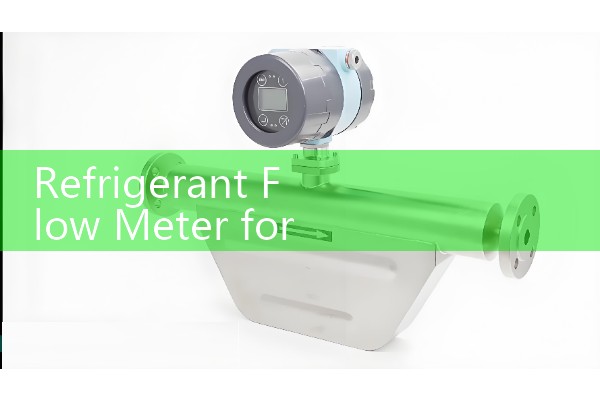
Silver Instruments offers the SIL-CM series with DN10 to DN80 sizes, covering flow ranges from 2 kg/h to 60,000 kg/h. The sensors are made of 316L stainless steel with a secondary containment shell rated to 100 bar. The signal converter delivers 4-20 mA HART, pulse, and Modbus. It also outputs media temperature via a built-in PT100, with an accuracy of ±0.2 °C. Because the meter is immune to flow profile distortion, you do not need long straight runs. A 3D bend or tee upstream is acceptable. This saves space on packaged chillers and refrigeration skids.
Installation Rules to Guarantee Single-Phase Ingest
Place the meter in a vertical pipe with upward flow whenever possible. This layout keeps any residual vapor moving and prevents bubble accumulation in the sensor tubes. Keep the meter body packed with liquid at all times, even during shutdown. Install a transparent sight glass just downstream. If you see no bubbles at full load and at part load, your subcooling is adequate. An oil separator in the liquid line also helps avoid two-phase issues where oil absorbs small amounts of refrigerant.
<
Real Application: A Chiller Test Bench Upgrade in Thailand
Last year, a chiller manufacturer in Thailand needed to validate compressor performance with precise refrigerant mass flow. Their test bench used a turbine meter with density correction, but data scatter was ±4% between morning and afternoon runs. We replaced it with a SIL-CM15 Coriolis meter, set up on the subcooled liquid line after the condenser. We enforced a 6 °C subcooling target by trimming the cooling water valve. The new mass flow data had a repeatability of ±0.05% and the test bench could meet ISO 5151 tolerances. The customer also used the density signal to automate the water valve, keeping subcooling steady regardless of outdoor heat load. The cost of the Coriolis meter was recovered in two months through fewer reject units and better compressor selection data.
Silver Instruments Coriolis Meter Specs for Subcooled Refrigerant
The SIL-CM series covers DN10, DN15, DN25, DN40, DN50, and DN80. Accuracy for liquid is ±0.1% of rate with a zero stability down to 0.01% of full scale. Density accuracy is ±0.5 kg/m³. Temperature accuracy is ±0.2 °C. The meter handles fluid temperatures from -40 °C to +150 °C and process pressures up to 100 bar. Secondary containment gives extra leak protection for flammable refrigerants like R290. Our meters are fully welded and bubble-tight, with no gaskets or O-rings in contact with the process. We supply explosion-proof versions certified for ATEX Zone 1 and IECEx. Output options include 4-20 mA HART, pulse, frequency, and RS485 Modbus. The local display shows mass flow, density, temperature, and totalizer. All SIL-CM meters leave our Nanjing factory with a calibration certificate traceable to national standards. We support on-site zero verification with a simple block valve procedure.
Frequently Asked Questions
Q: What minimum subcooling does Silver Instruments recommend for R410A at the flow meter inlet?
A: We recommend 5 °C minimum subcooling measured right before the meter. For systems with long vertical risers or high ambient, maintain 8 °C to be safe. This prevents flash gas from forming after any small pressure drop in the connecting pipe or flange gasket.
Q: Can a Coriolis meter handle a brief two-phase condition without damage?
A: Yes. Our SIL-CM meters can tolerate occasional small bubbles. The meter will continue measuring but may show a density drop and slightly higher noise. However, prolonged slug flow can accelerate tube wear. It is better to fix the subcooling problem.
Q: Do I need straight pipe upstream of the Coriolis meter?
A: No. Coriolis meters are insensitive to velocity profile. You can mount the meter directly after a bend, a tee, or a valve. You do not need 10D or 20D straight runs. This is a big advantage when retrofitting into tight refrigeration packages.
Q: Which output signals do you provide for a chiller PLC?
A: Standard outputs are 4-20 mA HART and RS485 Modbus. You can assign mass flow, density, or temperature to the analog output. The meter also gives a scalable pulse output for totalization and a relay output for flow alarm. We can pre-configure the outputs for your PLC before shipment.
Q: How do I request a quote for a refrigerant flow meter?
A: Send your refrigerant type, operating pressure (bar), minimum and maximum liquid temperature (°C), pipe size (DN), and required flow range (kg/h). We will select the correct SIL-CM model and provide a price and lead time. Email your specifications to [email protected], call +86-25-68650347, or reach us on WhatsApp at +86-25-52155837. Silver Automation Instruments supplies Coriolis meters and pressure transmitters to contractors, OEMs, and distributors across Southeast Asia, the Middle East, Africa, Oceania, and Latin America.